SINOSWAN Makes Outdoor Events Grander, Quicker, Safer.
How Is a Mobile Banquet Hall Manufactured?
A mobile banquet hall is not simply a trailer with furniture installed inside.
Behind a finished banquet vehicle is an integrated manufacturing process involving vehicle engineering, steel-structure fabrication, hydraulic engineering, mechanical design, electrical systems, interior finishing, environmental control, safety systems, assembly, testing, and final commissioning.
For SINOSWAN, the production of a mobile banquet vehicle is therefore an industrial engineering process rather than a simple vehicle conversion.
From the first steel frame to the final hydraulic movement, every major system has to work together. The vehicle must remain stable during transportation, expand safely at the destination, provide sufficient usable interior space, and repeatedly complete lifting, expansion, rotation, and other mechanical movements during operation.
This is particularly important for SINOSWAN’s SBT series mobile banquet halls, which are designed to transform from a transportable vehicle into a functional temporary indoor space for applications such as weddings, conferences, hospitality, gatherings, and other events.
The SBT1712, for example, is configured as a mobile banquet hall trailer with hydraulic roof lifting and hydraulic stage expansion, rotation, and lifting functions. Its documented configuration includes a welded steel frame, reinforced supports, steel stage panels, customized doors, aluminum panels, tempered glass, composite flooring, electrical systems, ventilation, lighting, and air-conditioning equipment.
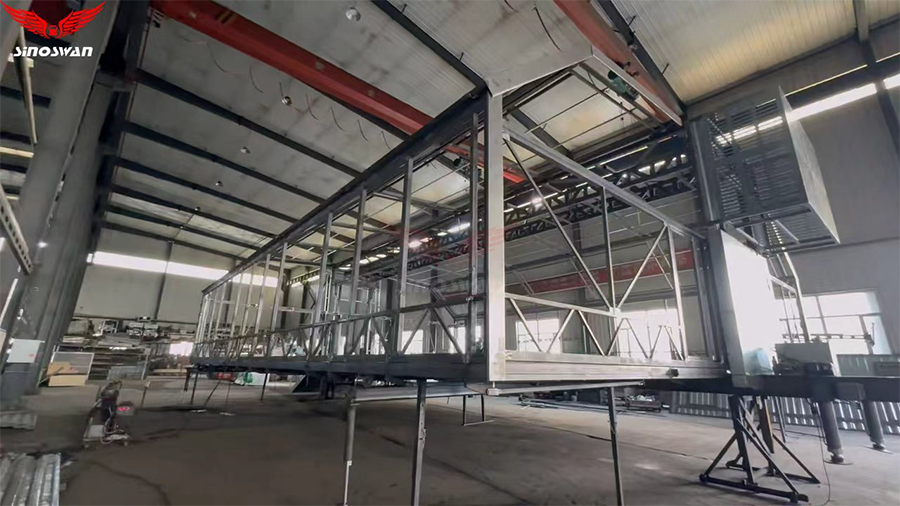
Before production begins, the banquet vehicle has to be considered as a complete mechanical system.
A mobile banquet hall has two fundamentally different operating conditions.
During transportation, it is a road-going vehicle.
After arriving at the destination, it becomes an expandable building-like space.
This means that the engineering team has to consider both conditions simultaneously.
The structure must withstand transportation loads while also supporting the loads generated when the vehicle is expanded.
The hydraulic system must provide controlled movement.
The support system must maintain stability.
The electrical system must operate safely.
The interior must provide a comfortable usable environment.
Doors, windows, flooring, lighting, ventilation, air conditioning, and emergency access must all be integrated into the overall design.
This is why mobile banquet vehicle manufacturing requires coordination between several engineering disciplines rather than relying on a single fabrication process.
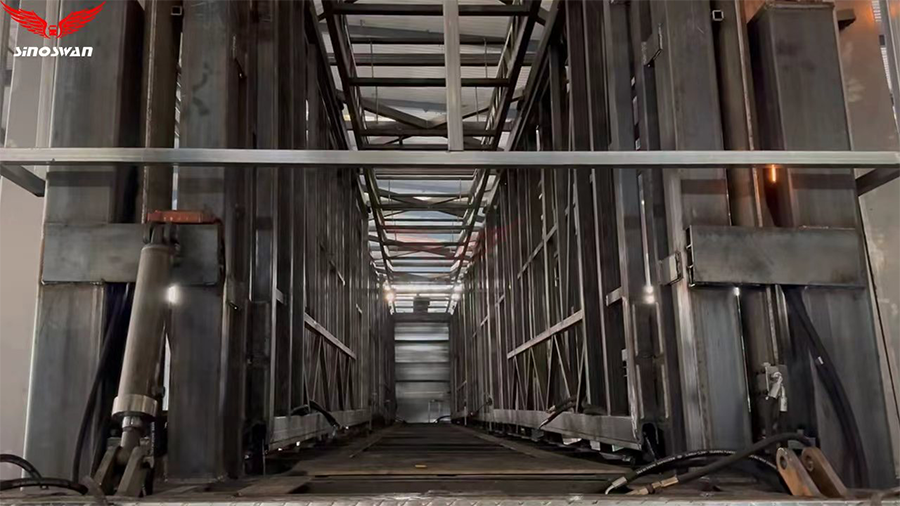
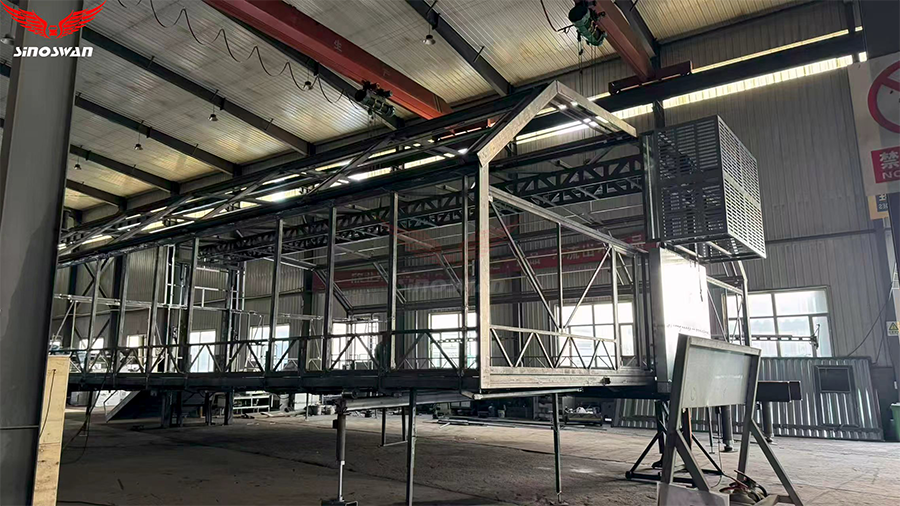
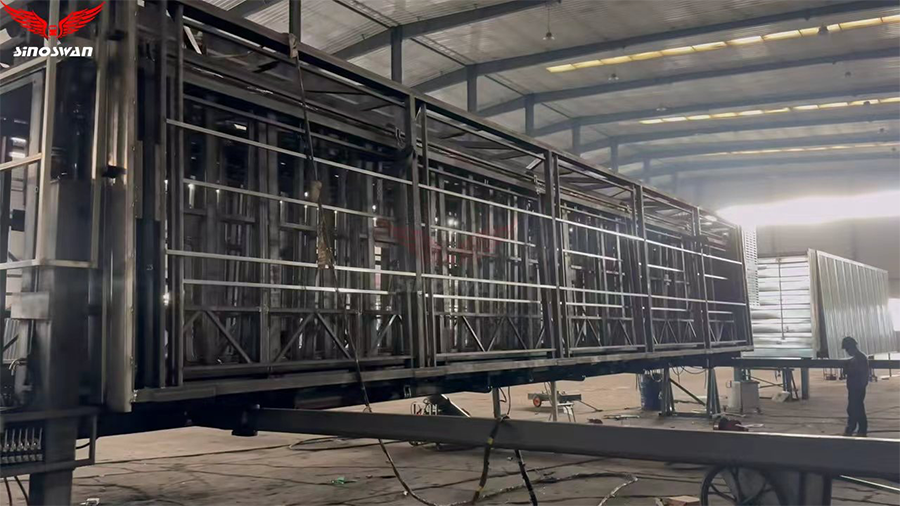
The manufacturing process begins with the main structural framework.
For the SBT1712 configuration documented in SINOSWAN’s technical materials, the main structure uses a welded steel frame with structural reinforcement and corrosion/rust treatment.
The steel structure is the foundation of the entire banquet vehicle.
It determines the basic geometry of the vehicle and provides the structural support for the roof, expansion mechanisms, floor, walls, doors, interior systems, and hydraulic components.
At this stage, dimensional accuracy is particularly important.
The frame cannot simply be welded according to appearance. The positioning of structural members affects later installation of:
✬Hydraulic cylinders
✬Roof mechanisms
✬Expansion platforms
✬Support legs
✬Doors
✬Windows
✬Interior panels
✬Electrical equipment
✬Air-conditioning systems
✬Flooring
✬Safety components
A dimensional error at the structural stage can become a much larger problem during final assembly.
Therefore, manufacturing quality begins long before the hydraulic system is installed.
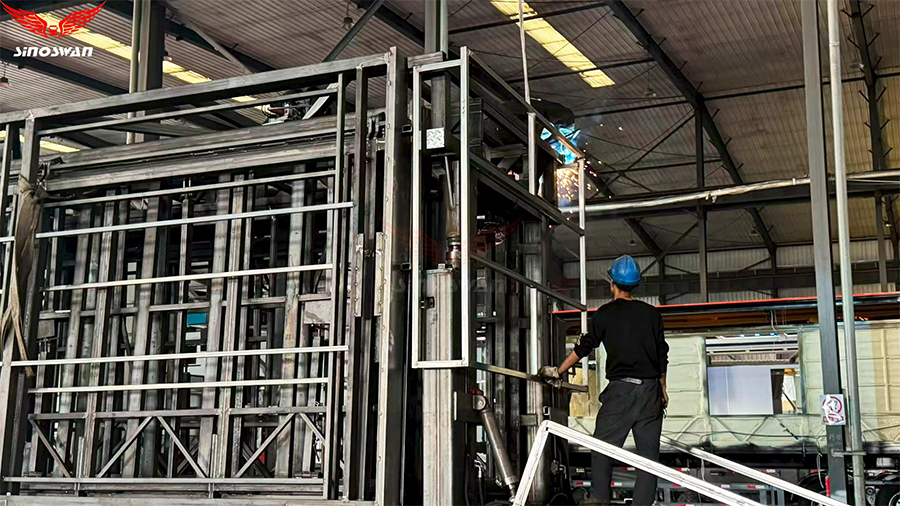
➤The hydraulic system is one of the most important engineering components of a modern mobile banquet vehicle.
➤Unlike a conventional static building, the banquet vehicle has to change its physical configuration.
➤The roof may need to rise.
➤The side structures may need to expand.
➤The platform may need to move.
➤Some configurations require rotation or lifting.
➤All of these movements need controlled mechanical power.
➤For the SBT1712 configuration, the documented functions include:
➜Hydraulic roof lifting
➜Hydraulic stage expansion
➜Hydraulic stage rotation
➜Hydraulic stage lifting
➜Reinforced support structures
➤The roof can be hydraulically lifted to approximately 4,000 mm in the documented configuration.
➤This means that the hydraulic system is not an accessory added after the vehicle has been built.
➤It is integrated into the fundamental architecture of the banquet hall.
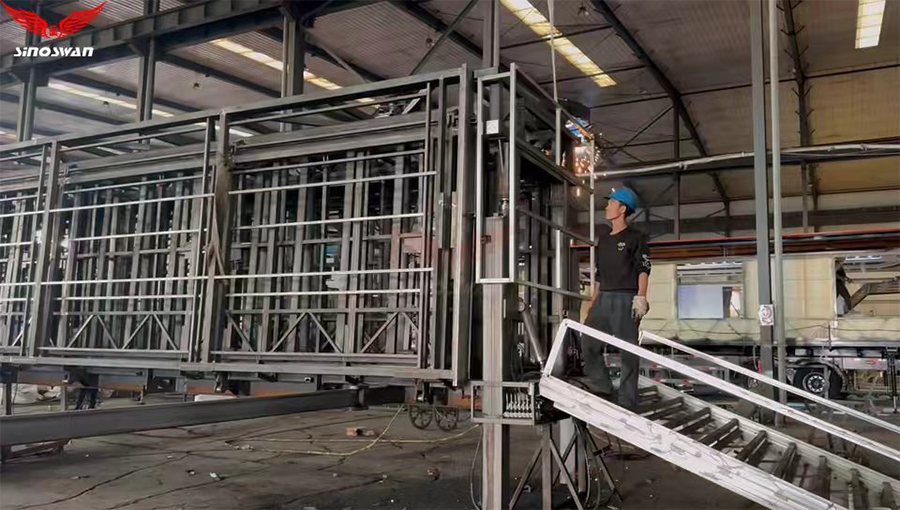
For SINOSWAN, hydraulic engineering is one of the key technologies behind expandable mobile event equipment.
A banquet vehicle may contain several moving structures that must operate in coordination.
The challenge is not simply to make a component move.
The engineering challenge is to make it move:
➜Smoothly.
➜Precisely.
➜Safely.
➜Repeatedly.
➜Under changing loads.
A hydraulic system has to convert hydraulic pressure into controlled mechanical movement through cylinders, valves, pipelines, pumps, control systems, and structural mechanisms.
When multiple moving components operate together, the hydraulic system becomes an integrated control problem.
➤This is where engineering experience becomes important.
➤The hydraulic system has to match the structural design.
➤The cylinder stroke has to match the required movement.
➤The mounting position has to match the mechanical geometry.
➤The hydraulic pressure and flow have to correspond to the required load and movement speed.
➤The support structure has to accommodate the forces generated during operation.
➤The control system has to allow the operator to perform the movement in a controlled sequence.
➤This integration is one of the most technically demanding parts of producing an expandable banquet vehicle.
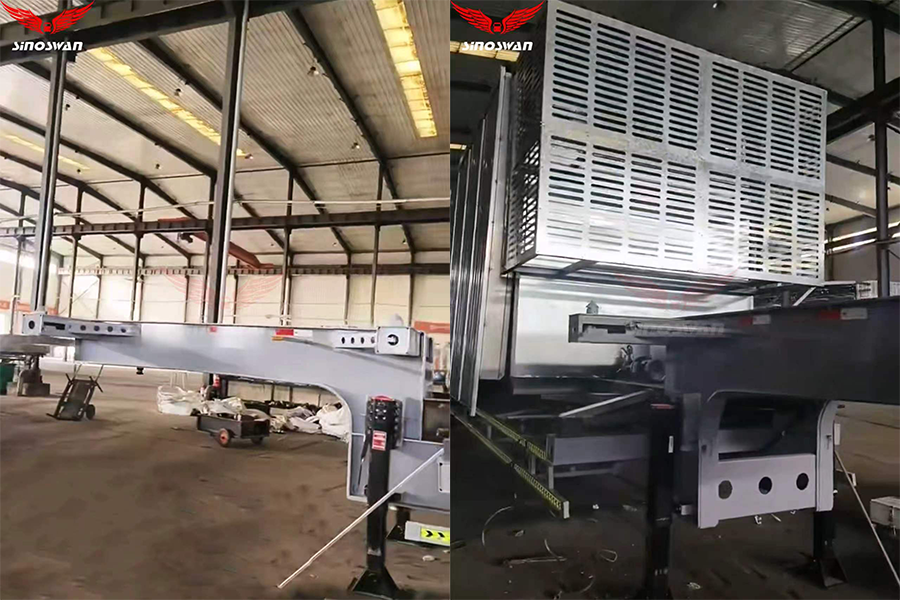
SINOSWAN’s current technical positioning places particular emphasis on its fifth-generation hydraulic technology for mobile event equipment.
The concept behind this development is not simply increasing hydraulic power.
The objective is to integrate hydraulic power, mechanical structure, control, safety, and deployment into a more coordinated system.
For a mobile banquet vehicle, this means the hydraulic system has to work as part of the entire vehicle architecture.
The fifth-generation hydraulic approach is intended to support:
✓More coordinated movement
✓More controlled deployment
✓Greater integration between hydraulic and mechanical systems
✓Improved operational efficiency
✓Better adaptation to complex expandable structures
✓Repeatable deployment and retraction
✓Integrated safety control
The technology is particularly relevant to mobile structures because the vehicle must repeatedly transition between two fundamentally different states:
Transport configuration → Expanded operating configuration
and then:
Expanded operating configuration → Transport configuration
The engineering challenge is therefore not only power generation but controlled transformation.
The hydraulic engineering capability associated with SINOSWAN’s development is connected with the broader research environment of Yanshan University, particularly its work in fluid transmission and control and mechatronic-hydraulic integrated systems.
Yanshan University’s official research profiles document substantial research activity in hydraulic engineering.
One university team working in new intelligent flow-control components and hydraulic system-group intelligent control and reliability evaluation reports research funded through national key R&D projects, National Natural Science Foundation projects, provincial projects, and extensive enterprise cooperation. The team’s research includes intelligent hydraulic systems, high-performance hydraulic components, and large hydraulic equipment.
Another Yanshan University research team in intelligent equipment mechatronic-hydraulic integration reports work in areas including advanced forging hydraulic equipment, fully hydraulic wind-power systems, high-pressure and ultra-high-pressure hydraulic components, hydraulic robotic systems, and aerospace hydraulic components and systems. The university describes extensive cooperation between these research teams and industry.
This academic and engineering background is relevant to SINOSWAN’s emphasis on hydraulic technology.
Rather than treating the hydraulic system as a standard off-the-shelf component, the engineering philosophy is to develop the hydraulic system together with the mechanical structure and application requirements of the mobile vehicle.
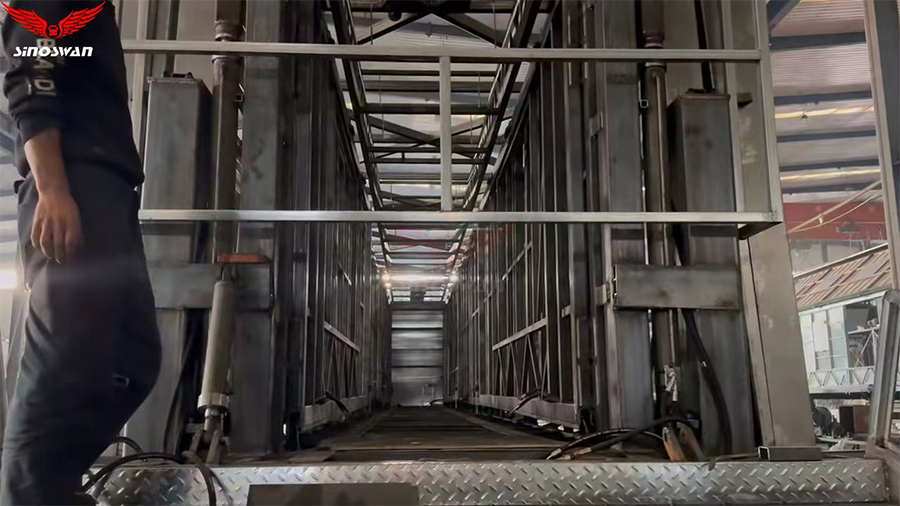
A high-performance hydraulic system is not defined by a single hydraulic cylinder.
The complete system includes multiple interacting components.
Depending on the vehicle configuration, these may include:
✦Hydraulic power unit
✦Hydraulic pumps
✦Hydraulic cylinders
✦Hydraulic valves
✦Hydraulic pipelines
✦Pressure-control components
✦Flow-control components
✦Mechanical supports
✦Hydraulic control circuits
✦Operator controls
✦Safety mechanisms
The important engineering relationship is:
Hydraulic power → hydraulic control → mechanical movement → structural deployment
If one part is not correctly matched, the entire deployment process can be affected.
For example, a cylinder with sufficient force but unsuitable stroke length cannot achieve the required movement.
A hydraulic system with sufficient pressure but inappropriate flow control may produce undesirable movement characteristics.
A structurally strong mechanism can still perform poorly if the hydraulic system is not properly matched to its load.
Therefore, SINOSWAN’s banquet vehicle production integrates hydraulic engineering into the mechanical design rather than treating it as a separate subsystem.
After the main structure and hydraulic mechanisms are prepared, the expansion components are integrated into the vehicle.
For the SBT1712 configuration, the documented design includes reinforced support legs and hydraulic movement for the expandable structures.
The support system is particularly important because the vehicle changes from a transportation platform into an occupied event space.
During transportation, the structure is compact.
During operation, the structure expands.
The support system therefore has to provide a stable interface between the expanded structure and the ground.
This is one reason why mobile banquet vehicle engineering differs from ordinary trailer manufacturing.
The manufacturer is effectively engineering a movable structure that has to satisfy two different operating modes.
The floor is another structural and functional part of the banquet vehicle.
For the documented SBT1712 configuration, the stage uses 8 mm steel panels, together with anti-slip flooring and reinforced structural supports.
The flooring has several functions.
It provides a finished walking surface.
It contributes to the usable interior environment.
It must work with the underlying structural system.
It must also remain suitable for repeated deployment and transportation.
For banquet applications, flooring additionally contributes to the visual appearance of the interior.
This is why SINOSWAN’s banquet vehicle manufacturing combines structural engineering with interior engineering rather than treating the two as completely separate processes.
Once the major structural components are installed, the vehicle begins to take on the appearance of a banquet hall.
The SBT1712 documentation includes:
▗Customized dual-opening steel doors
▗Aluminum panels
▗Tempered glass
▗Wood finishes
▗Composite flooring
The doors and windows are not simply decorative elements.
Their dimensions, locations, opening directions, structural connections, and relationship to the expanding structure all need to be coordinated during production.
The exterior panels also have to work with the underlying structure while maintaining the intended appearance of the finished vehicle.
This is where industrial fabrication transitions into finished product manufacturing.
A mobile banquet hall needs much more than structural expansion.
Once expanded, it has to function as an event space.
The documented SBT1712 configuration includes:
▗Integrated lighting
▗Ventilation
▗Complete wiring
▗Distribution box
▗LED circuits
▗24 V circuits
▗Central air conditioning
▗Other electrical equipment depending on configuration
The technical configuration lists six Haier central air-conditioning units.
Electrical integration therefore becomes another major production stage.
The electrical system has to be organized within a mobile structure while maintaining access for maintenance and ensuring that the various systems can operate together.
The result is a vehicle that is not simply mechanically expandable but functionally usable as an indoor event environment.
The final appearance of a banquet vehicle depends heavily on the interior finishing process.
A mobile banquet hall may be used for:
▗Weddings
▗Conferences
▗Meetings
▗Hospitality
▗Gatherings
▗VIP reception
▗Other temporary indoor events
Therefore, the interior needs to balance structural practicality with visual presentation.
Depending on the project, the interior can incorporate different combinations of:
▗Wood finishes
▗Aluminum panels
▗Tempered glass
▗Composite flooring
▗Lighting
▗Ventilation
▗Air conditioning
▗Decorative elements
▗Doors and windows
For customized banquet vehicles, these elements can be developed around the customer’s intended application and interior requirements.
A mobile banquet hall has to be safe in both transportation and operating conditions.
The documented SBT1712 configuration includes several safety-related elements, including:
▗Dual safety chains
▗Mechanical/electric brakes
▗Emergency exit
▗Special-access entrance
▗Reinforced support legs
▗DOT taillights
▗Wheel covers
These components illustrate an important principle in mobile vehicle manufacturing:
Safety cannot be added only at the end of production.
It has to be considered throughout the design.
The structural system, hydraulic system, support system, electrical system, transportation system, access system, and emergency provisions all contribute to the overall operating safety of the vehicle.
One of the most important stages of banquet vehicle manufacturing is testing.
A vehicle with multiple hydraulic movements cannot simply be visually inspected and considered complete.
The hydraulic system needs to be operated.
The moving components need to be checked.
The structure needs to be observed during deployment.
The electrical systems need to be tested.
The expansion and retraction process needs to be confirmed.
The purpose is to verify that the individual systems operate together as an integrated vehicle.
For a hydraulic banquet hall, testing should include the complete operating sequence:
↓Transport configuration
↓Positioning
↓Support deployment
↓Hydraulic activation
↓Roof lifting
↓Expansion
↓Platform movement
↓Interior preparation
↓Final operating configuration
↓Retraction
↓Transport configuration
This full-cycle approach is particularly important for equipment that may be repeatedly deployed during its service life.
After the main systems have been installed and tested, the vehicle enters final inspection.
At this stage, the manufacturing team checks the integration of:
▗Structural components
▗Hydraulic components
▗Support systems
▗Doors and windows
▗Flooring
▗Electrical systems
▗Lighting
▗Air conditioning
▗Interior finishing
▗Safety equipment
▗Vehicle components
The final inspection is not only about whether the banquet vehicle looks finished.
It is about whether the different systems work together.
A banquet vehicle is a complex integrated product.
Its quality depends on the relationship between its individual systems.
The production of a mobile banquet vehicle demonstrates more than the ability to weld a trailer.
It demonstrates the ability to coordinate several manufacturing disciplines within one project.
A completed banquet vehicle represents the integration of:
▗Structural manufacturing
▗Hydraulic engineering
▗Mechanical engineering
▗Electrical engineering
▗Interior manufacturing
▗Vehicle engineering
▗Assembly
▗Testing
▗Quality control
This is why banquet vehicle production can be used as a practical demonstration of SINOSWAN’s broader industrial manufacturing capability.
The documented SBT1712 production cycle is approximately 65–70 days for manufacturing, followed by an estimated 30–45 days for shipping, depending on the project and logistics conditions.
The manufacturing period reflects the amount of work required to integrate the vehicle structure, hydraulic mechanisms, interior systems, electrical equipment, and finishing into one finished mobile facility.
Production capacity is not only measured by how many vehicles leave a factory.
For customized mobile event equipment, capacity also means the ability to repeatedly manufacture complex systems with controlled quality.
Hydraulic engineering is particularly important because it is directly connected to the most visible transformation of the vehicle.
A conventional trailer remains largely the same during operation.
A hydraulic banquet vehicle changes configuration.
The roof moves.
The structure expands.
The platform changes.
The support system engages.
The vehicle becomes an event space.
Therefore, hydraulic engineering becomes one of the technologies that determines whether the complete product can operate as intended.
This makes the hydraulic system both a technical subsystem and a central part of the product’s industrial value.
The relationship between university-level hydraulic research and industrial manufacturing is particularly relevant to this type of equipment.
Yanshan University’s official research profiles show long-term work in fluid transmission and control, hydraulic systems, intelligent mechatronic-hydraulic equipment, high-pressure hydraulic components, and industrial technology transfer.
The university’s research teams have also participated in extensive enterprise cooperation and technology-transfer projects.
For mobile banquet vehicle manufacturing, this type of research background provides a technical foundation for addressing problems involving hydraulic movement, system control, structural coordination, and reliability.
SINOSWAN’s engineering approach is therefore centered on applying hydraulic technology to a real industrial product: a mobile structure that must repeatedly transform between transportation and event-use configurations.
It would be too simple to describe the hydraulic system as merely a mechanism that lifts the roof.
The hydraulic system is part of the vehicle’s operating logic.
For an expandable banquet hall, hydraulic engineering can control multiple movements and connect those movements with the structural design. This creates a chain:
Hydraulic power→Hydraulic control→Cylinder movement→Mechanical transmission→Structural expansion→Finished event space
The engineering quality of the complete vehicle therefore depends on how accurately these stages are matched.
This is also why hydraulic technology is an important indicator of the manufacturer’s engineering capability.
A hydraulic technology claim is ultimately meaningful only when it can be demonstrated through a physical product.
The manufacturing process makes that technology visible.
The customer can see:
▗The structural frame
▗The hydraulic cylinders
▗The hydraulic pipelines
▗The expansion mechanisms
▗The support system
▗The lifting roof
▗The movable platform
▗The finished interior
▗The electrical system
▗The completed vehicle
The final product is therefore the physical result of multiple engineering disciplines working together.
For SINOSWAN, the banquet vehicle factory is not simply an assembly location.
It is where design, hydraulic engineering, structural manufacturing, electrical integration, interior production, and testing are brought together into one finished mobile event facility.
The SBT series represents a different category from conventional mobile stages.
A mobile stage primarily provides a performance platform.
A mobile banquet hall provides an enclosed or expandable event environment.
This makes the engineering requirements different.
A banquet vehicle may need to accommodate:
▗Guests
▗Tables and chairs
▗Catering
▗Meetings
▗Weddings
▗Hospitality
▗Air conditioning
▗Lighting
▗Ventilation
▗Interior decoration
▗Access and emergency exits
The vehicle therefore has to combine the engineering characteristics of a road vehicle, expandable structure, temporary building, and event facility.
That combination is what makes the production process technically demanding.
The production of an SBT banquet vehicle demonstrates several areas of manufacturing capability.
▶Structural manufacturing
SINOSWAN manufactures the main welded structural framework and integrates reinforced support structures.
▶Hydraulic engineering
The vehicle incorporates hydraulic systems for roof lifting and expandable mechanical functions.
▶Mechanical integration
The hydraulic mechanisms have to operate together with the steel structure, support legs, floor, roof, and expansion systems.
▶Electrical integration
Lighting, wiring, distribution, LED circuits, ventilation, and air-conditioning systems are incorporated into the finished vehicle.
▶Interior manufacturing
Doors, windows, aluminum panels, glass, flooring, wood finishes, and other interior elements are integrated into the mobile structure.
▶Vehicle engineering
The complete system must remain transportable and functional as a road-going vehicle.
▶Testing and commissioning
The different systems have to be checked as an integrated product before delivery.
This combination is what turns a basic trailer into a sophisticated mobile banquet facility.
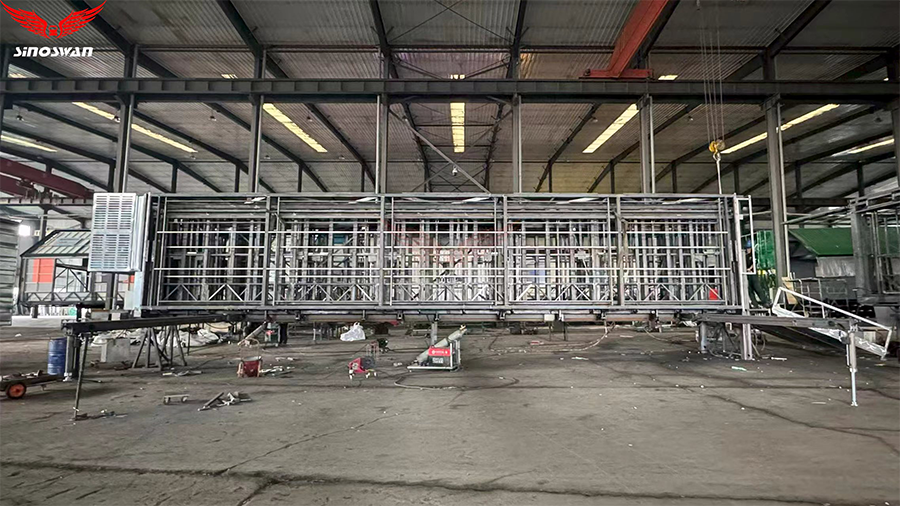
One of the most important concepts behind SINOSWAN’s banquet vehicle manufacturing is that the product is essentially a factory-built mobile space.
Instead of constructing a temporary hall entirely at the event location, major structural and functional systems are manufactured and integrated at the factory.
The factory therefore controls much of the manufacturing process before the vehicle reaches its destination.
This approach provides a controlled environment for:
✰Structural fabrication
✰Hydraulic installation
✰Electrical wiring
✰Interior installation
✰Equipment integration
✰System testing
✰Quality inspection
Once the vehicle reaches its destination, the operating process is focused on deployment rather than constructing the entire facility from separate raw materials.
✰A mobile banquet vehicle is not designed for a single transformation.
✰Its fundamental purpose is mobility.
✰It may need to be transported, deployed, used, retracted, transported again, and redeployed.
✰That creates a different engineering requirement from a conventional permanent building.
✰The structural system must accommodate movement.
✰The hydraulic system must support repeated operation.
✰The doors and panels must remain functional.
✰The electrical system must remain protected.
✰The interior must withstand the mobile operating environment.
✰The support system must work repeatedly.
Therefore, durability and system integration are fundamental aspects of banquet vehicle manufacturing.
The complete manufacturing process can be summarized as:
This is the manufacturing chain behind a finished SINOSWAN mobile banquet vehicle.
The finished banquet vehicle is therefore a visible representation of several layers of engineering capability.
✰At the bottom is the structural system.
✰Above that is the mechanical expansion system.
✰Controlling the movement is the hydraulic system.
✰Supporting the event environment are the electrical, lighting, air-conditioning, and ventilation systems.
✰Finally, the interior finishing converts the engineered structure into a usable event space.
The product only works when all these systems work together.
That is the central engineering principle behind SINOSWAN’s banquet vehicle manufacturing.
➤Frequently Asked Questions About SINOSWAN Banquet Vehicle Manufacturing
✦How is a mobile banquet vehicle manufactured?
A mobile banquet vehicle is manufactured through a multi-stage process covering engineering design, steel-structure fabrication, hydraulic-system installation, expansion mechanisms, flooring, exterior panels, doors and windows, electrical systems, air conditioning, interior finishing, safety components, testing, and final commissioning.
✦What is the most important technology in a hydraulic banquet vehicle?
The hydraulic system is one of the core technologies because it controls the movement of the expandable structure. The hydraulic system has to be matched with the mechanical structure, load, movement requirements, and control system.
✦What hydraulic functions can the SBT1712 perform?
The documented SBT1712 configuration includes hydraulic roof lifting and hydraulic stage expansion, rotation, and lifting.
✦How high can the SBT1712 roof lift?
The documented configuration specifies hydraulic roof lifting up to approximately 4,000 mm.
✦What is the SBT1712 made from?
The documented configuration uses a welded steel frame, steel structural components, aluminum panels, tempered glass, composite flooring, and other specified materials depending on the final configuration.
✦Does SINOSWAN manufacture the banquet vehicle or only assemble equipment?
The production process described for the SBT series includes structural fabrication, hydraulic integration, electrical installation, interior finishing, equipment integration, and testing. This demonstrates an integrated manufacturing process rather than simply adding event equipment to an existing trailer.
✦How long does it take to manufacture an SBT1712?
The available SBT1712 technical information gives an estimated manufacturing period of approximately 65–70 days, with shipping estimated separately at approximately 30–45 days. Actual schedules depend on the project configuration and logistics.
✦What is the role of Yanshan University in hydraulic technology?
Yanshan University has established research teams and academic expertise in fluid transmission and control, hydraulic systems, intelligent mechatronic-hydraulic equipment, and high-performance hydraulic components. Its official profiles also document extensive national research projects and enterprise cooperation.
✦What is SINOSWAN’s fifth-generation hydraulic technology?
SINOSWAN describes its current hydraulic development as a fifth-generation hydraulic technology approach focused on integrating hydraulic power, control, mechanical movement, structural deployment, and safety into mobile event equipment.
✦Is the fifth-generation hydraulic technology independently verified as “world-leading”?
The current public evidence reviewed for this article does not establish an independent third-party certification or academic assessment specifically describing SINOSWAN’s banquet-vehicle hydraulic system as “world-leading.” The article therefore presents the fifth-generation designation as SINOSWAN’s technology positioning rather than as an independently verified ranking.
➤Conclusion: Engineering a Mobile Banquet Hall From the Inside Out
The production of a mobile banquet vehicle demonstrates the difference between a conventional trailer and an engineered mobile event facility.
From the initial welded steel frame to the final interior, the manufacturing process requires the integration of structural engineering, mechanical systems, hydraulic technology, electrical engineering, vehicle systems, interior manufacturing, safety systems, assembly, and testing.
The hydraulic system is particularly important because it enables the vehicle to transform from a transport configuration into an operating event space.
For the SBT series, documented functions include hydraulic roof lifting, expansion, rotation, and lifting. The SBT1712 configuration also demonstrates the integration of steel structure, reinforced supports, flooring, doors, glass, electrical systems, lighting, ventilation, air conditioning, and safety equipment into one mobile banquet hall.
The connection with the hydraulic research environment of Yanshan University adds an important academic and engineering dimension to the technology background. Yanshan University’s official materials document substantial expertise in fluid transmission and control, hydraulic systems, intelligent mechatronic-hydraulic equipment, and high-performance hydraulic components, together with extensive research and enterprise cooperation.
For SINOSWAN, the goal is not simply to manufacture a vehicle that can expand.
The goal is to manufacture a mobile event space whose structure, hydraulic system, electrical system, interior, and safety components operate together as one engineered product.
For inquiries and detailed specifications:
www.sinoswan.com
info@sinoswan.com
WhatsApp: +86 188 3895 0310/+86 186 3717 8390/ +8618538129701