Sinoswan will be leading hydraulic mobile stage trailer manufacturers in 2025-2026, and there will be a variety of different models with different sizes, specifications, and prices. Depending on size and features, real costs are usually in the range of a base price of approximately $30,000 of small units to way beyond $100,000 of large, professional stages on semi-trailers.
Mobile Stage Trailers have revolutionized the production of outdoor events, concerts, brand activations, and social gatherings. Modern hydraulic systems enable a full professional stage to be erected in a short, safe, and consistent period of time, as opposed to the sophisticated scaffolding and lengthy setup required by traditional methods. This guide aims to assist event planners, rental firms, cities, and marketing firms in understanding the actual costs, technical requirements, safety measures, and the most suitable model for the year 2026.
The Mobile Stage Trailers are custom-designed platforms that are mounted on trailers that can be driven on the roads and are driven by hydraulic lifting systems. They are also designed to open to higher performance levels without cranes or any external equipment, which lessens manpower and enhances safety.
The Hydraulic Mobile Stage Trailer demand has been increasing in the year 2026 because of the increase in outdoor entertainment, government-supported events like cultural and experiential brand marketing. In North America, Europe, the Middle East, as well as the Asia-Pacific markets, there is a heavy investment in Mobile Hydraulic Stages with fast deployment, modular design, and the ability to meet more stringent safety regulations. Consumers are becoming more concerned with wind load ratings, built-in power, and flexibility in touring schedules.
Mobile Stage Trailers are now a pivotal product in today’s outdoor and indoor events. These mobile stages can be used not only in concerts or festivals but also in corporate advertising or government programs since they are fast, safe, and presentable without the necessity of permanent construction. This guide clarifies all that buyers need to know before they invest in the right system.
A Hydraulic Mobile Stage Trailer is a complete stage that is packed on a trailer frame. The stage opens, raises, and balances in a minimal assembly period using hydraulic power. These trailers, unlike conventional truss-based stages, eliminate the need to use labor and enhance safety and performance in various venues.
The hydraulic system operates the roof raising, stage extension, side wings, and stabilizing legs. This automation enables rapid implementation and reduces the amount of human error in the implementation and dismantling.
The trailers can be used in versatility, and they are usually utilized in:
The mobility ensures that event organizers are able to cover multiple areas effectively and at the same time, maintain a professional level on stage.
One of the key buying factors is stage size. Smaller stages are good in local events, whereas bigger ones are needed in concerts and for big audiences. Buyers should evaluate:
The ability to select the right size guarantees performance and safety without an excessive amount of money wasted.
The trailer is based on the hydraulic system. Premium parts will provide easy lifting, accurate control, and reliability. Buyers should look for:
A properly designed hydraulic system minimizes loss of time and maintenance.
Stages are subject to the variability of weather during outdoor events. The wind load ratings and structural reinforcement are critical issues with respect to safety. Important elements include:
These characteristics safeguard performers, gear, and viewers in unforeseen settings.
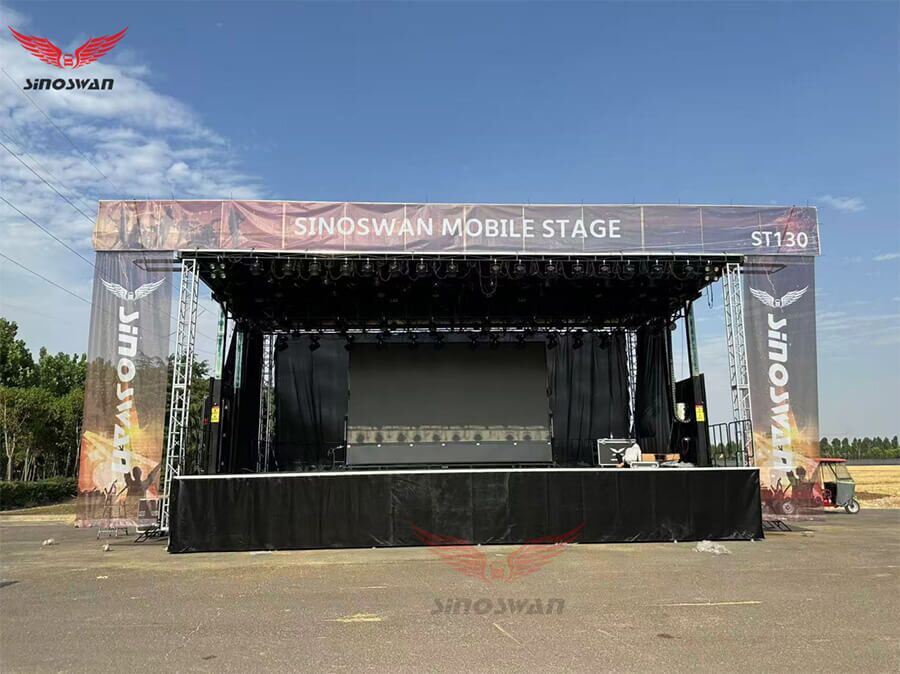
The international market has a number of manufacturers that supply the Hydraulic Stage Trailer at different capacities, automation degrees, and quality of construction. Knowledge of the model difference will enable buyers to pair the appropriate platform with their operational objectives.
The market has a variety of 15 models of hydraulic mobile stage trailers in order to meet the needs of various events of varying sizes. Smaller versions, such as the ST75 and ST80, give the benefit of small to mid-sized events that use compact stage sizes that can be set up quickly and have a stable hydraulic platform. The mid-range, such as the ST90PRO, ST100, and ST130 series, which offer an expandable deck and a stable hydraulic platform with a capacity of up to 15,000 people. The majority of the high-end units can be quickly switched to a Towable Elevated Stage Trailer format that can be deployed in both urban and rural settings.
|
# |
Model Name |
Approx. Stage Size / Area |
Deployment Time |
Audience Scale |
Key Features / Notes |
|
1 |
ST75 Mobile Stage Trailer |
Compact hydraulic stage |
Under 20 minutes |
Small to mid-size events |
Lightweight design, fast setup, easy transport |
|
2 |
ST80 Mobile Stage Trailer |
Medium-size expandable stage |
20–40 minutes |
3,000–5,000 |
Expandable deck, stable hydraulic lifting system |
|
3 |
ST90PRO Gooseneck Mobile Stage Trailer |
Approx. 32×20 ft (expandable) |
Around 40 minutes |
Mid-size outdoor events |
Gooseneck towing, improved stability and balance |
|
4 |
ST100 Hydraulic Mobile Stage Trailer |
Approx. 10 m × 9 m |
20–60 minutes |
5,000–10,000 |
Balanced size, suitable for community and commercial events |
|
5 |
ST130 Hydraulic Mobile Stage Trailer |
Approx. 12 m × 9 m |
20–60 minutes |
10,000–15,000 |
Semi-trailer structure, multimedia-ready configuration |
|
6 |
ST130 PLUS Hydraulic Mobile Stage Trailer |
Enhanced ST130 platform |
30–60 minutes |
Large outdoor events |
Extended deck, higher roof load capacity |
|
7 |
ST130 PRO Luxury Mobile Stage Trailer |
Large-format stage |
40–90 minutes |
10,000+ |
Premium build with advanced lighting and sound support |
|
8 |
ST150 PLUS Hydraulic Mobile Stage Trailer |
Approx. 12.7 m × 8.8 m |
20–60 minutes |
15,000–20,000 |
Extended stage floor, stronger structural frame |
|
9 |
ST150 PRO Luxury Mobile Stage Trailer |
Approx. 14 m × 12 m |
40–120 minutes |
30,000+ |
Festival-grade stage for major outdoor productions |
|
10 |
ST150 PRO Luxury (Extended Version) |
Up to 400+ m² (expandable) |
40–120 minutes |
50,000+ |
Ultra-large stage footprint with heavy-duty rigging |
|
11 |
ST170 PRO Luxury Mobile Stage Trailer |
Approx. 17 m × 12 m |
Around 20–40 minutes |
Very large events |
Extra-large hydraulic stage with high wind resistance |
|
12 |
Professional Hydraulic Mobile Stage Trailer (Multimedia Ready) |
Approx. 12 m × 8.6 m |
30–50 minutes |
Medium to large events |
Designed for integrated sound and lighting systems |
|
13 |
Hydraulic Mobile Stage Trailer with LED Compatibility |
Varies by configuration |
30–60 minutes |
Visual-focused events |
Optimized for LED screen and visual production needs |
|
14 |
Standard Hydraulic Mobile Stage Trailer |
Configurable |
30–60 minutes |
General outdoor events |
Flexible layout for multi-purpose event use |
|
15 |
Custom Hydraulic Mobile Stage Trailer Solutions |
Fully customized |
Varies |
Custom events |
Tailor-made designs based on specific project requirements |
Other popular brands target such niche demands as very fast deployment, extreme weatherizing, or small-town use. Although specifications differ, the manufacturers of the highest quality focus on certified hydraulics, extensions of the stage of modules, and adherence to the safety standards in the region.
The Hydraulic Mobile Stage Trailers investment should be compared with the performance, safety, and scalability standards. Appreciation of key attributes will guarantee sustainable performance.
The trailer is made up of a hydraulic system. The customers will require empty circuits, quality cylinders, and guarded hose routing. Regular and predictable performance of lifting under load is achieved through consistent hydraulics, which minimizes downtime and enhances consistency in lifting performance.
The benefits of modern Hydraulic Stage Trailers include fast deployment. Premium models can switch transport mode to full stage configuration within minutes, which reduces the number of crew and labor expenses.
Approved wind load rating and structural analysis are essential. High-quality units are tested to endure against the strong gusts and hold heavy equipment, so that the performers and the crew would be safe.
Durable frames, corrosion-resistant coatings, coupled with reinforced decking, increase service life. Most of the manufacturers are now using steel frames with lightweight aluminum panels, maximizing the strength-to-weight ratios.
The wings, roof extensions, and modular decks are customizable to accommodate events of various sizes using a single trailer. This flexibility enhances the utilization of rentals and ROI.
Modern consumers are increasingly shrewd on pre-fuelled power supply, mounting brackets, and connection to digital media. Some of the designs can also feature a mobile LED screen trailer system to enhance the visual effect.
The real-world cost is known to be more than the purchase price. Technical needs such as axle rating, hydraulic capacity, and structure tolerances directly impact both investment cost and long-run cost of operation. In order to make a final purchase, customers should look at documents and test reports correctly.
Cost:
Key Specifications:
New Hydraulic Mobile Stage Trailers are inexpensive, starting at $45000, and may be used at small community events. The mid-range automation models that have a higher load rating fall within the price range of $75,000-120,000. Custom models may cost up to and over $180,000, exclusive concert-grade models with add-on hydraulics, wider roofs, and customized systems.
Various factors determine the price, including stage size, hydraulic complexity, material quality, certification requirement and optional integration. Transport compliance, warranty coverage, and after-sales support are other significant elements of total ownership cost.
To choose the appropriate unit, it is necessary to match technical competencies with event requirements and business strategy in the long run.
2. Towing Vehicle: Smaller trailers may be pulled by a typical pickup or SUV, but larger stages have to be drawn by a semi-horse.
3. Requirements of Setup: Keep in mind manpower and time. Hydraulic stages require less labor (hydraulic stages are designed to be quick and easy to deploy, 30-60 minutes) and are low-staffed.
4. Budget: Consider the initial cost of purchase or possible customization costs and the cost of maintenance. Although initial investment may be high, hydraulic systems lower the operating costs.
5. Optional Equipment: Choose whether you require an all-in-one solution with optional LED screens, lighting, and sound systems fully factory tested and pre-assembled.
6. Event Size and Audience Capacity Requirement: Small neighborhood events have different needs than large concerts. The addition of stage size and load rating according to audience size eradicates overspending or underspending.
7. Towing Vehicle Compatibility and Regulations: Trailer weight, axles, and brakes are to be consistent with towing vehicles that are in the market, as well as the local transport restrictions. This would ensure that there is legal compliance and transportation security.
8. Set-up Requirements and Crew Needs: One of the greatest advantages of the traditional mobile stage is reduced manpower. Hydraulic automation helps a smaller staff to handle assembling and disassembling.
9. Budget Planning and ROI over Long-Term: The higher initial investment returns are available in reliability, lower maintenance, and higher demand for the rental. The buyers are expected to calculate ROI in a few years.
10. Optional Equipment and Custom Add-Ons: Weather enclosures, power generators, or being compatible with a stage truck are custom options that can make the platform more versatile without having to acquire separate platforms.
The wind load ratings and certifications are manufacturer and model-specific. Comparisons of tested wind resistance levels, adherence to CE or other similar requirements, and reported safety margins should be done by buyers. The approved trailers are known to create security and a wider acceptance in the controlled places.
|
Model |
Wind Load Rating (Approx.) |
Roof Load Capacity |
Safety Certifications |
Notes |
|
ST100 Hydraulic Mobile Stage Trailer |
12–14 m/s (27–31 mph) |
High |
CE, TÜV Structural Load Test |
Designed for mid-sized outdoor events and community performances |
|
ST130 Hydraulic Mobile Stage Trailer |
13–15 m/s (29–34 mph) |
Very High |
CE, TÜV Structural Load Test |
Engineered for large gatherings with heavy lighting/audio rigs |
|
Optional Heavy-Duty Version (if available) |
Up to 15–17 m/s (34–38 mph) |
Very High |
CE, TÜV + Reinforced Roof System |
Suitable for demanding outdoor environments and high wind exposure |
The first step towards getting the right trailer is to identify the main uses of the trailer. A touring production can emphasize durability and quick assembly, whereas brand activations can emphasize a visual appeal and incorporate displays such as a handheld LED screen trailer. By comparing these needs with the technical specifications, one can have a viable and future-oriented investment.
Event Type and Usage Frequency:
Begin by identifying the type of events that you want to sponsor, such as concerts, crowdsourcing, road shows, or tours. The size and frequency of the event will determine the size and height of the stage, the height of the roof, and the mass that can be carried on the stage to run safely and professionally.
Deployment Speed and Operational Efficiency:
Establish the rate of stage setup and dismantling. High-end hydraulic systems can be deployed quickly with a minimal amount of manual intervention, and this reduces the cost of labor and makes the organization of any multi-day or back-to-back event easier.
Transport and Compliance:
Consider the overall length, weight, axle configuration plus towing requirement of the trailer. This makes sure that compatibility with the towing cars is also sustained, and that road laws in the area are also complied with to avoid transport restrictions, permit challenges, and delays in the logistics.
Environmental Resilience and Safety Features:
The outdoor activities need to be highly structured and certified to withstand the wind. Established wind load ratings and a stronger roofing framework will assist in ensuring that the operation is safe under the fluctuating weather conditions and that the performers and equipment are secured.
Structural Strength and Load Capacity:
Identify the stage deck and roof rigging to support lighting, sound systems, and others. The distribution of loads and engineered materials is necessary to ensure long-term durability and safe operation.
Hydraulic Mobile Stage Trailers are created to be reliable, safe, and flexible. Customers have the benefit of having the best hydraulics, universal standards, customized design,s and mighty after-sales services. These advantages make SINOSWAN a steady choice among all those professionals who wish to think about long-term value.
High-Reliability Hydraulic Systems:
The Mobile Stage Trailers are built using industrial-grade hydraulic cylinders, hydraulic pumps, and a control system that offers a smooth lift and level-up movement and a constant performance. Such systems are also set to be implemented regularly and also run over extensive time to reduce the possibilities of failure during active events.
Compliance with Global Safety and Quality Standards:
All trailers will be planned to meet international structural and safety standards. This will offer safer operation during other weather conditions, and it will enable organizers of such events to operate safely in various regions and under varying regulatory environments.
Custom-Built Configurations for Professional Use:
Our designs are tailor-made based on the size of the event, audience, roof loads, and stage size. The layouts are not restricted to concerts, public performances, or brand activities, and functionality is not affected in any way.
Good After-Sales Support and Service Network:
After-sales service, availability of spares, and technical support services will reduce downtime. This long-term support is a reliable option that will allow an investor to have a continuation of operations and secure investments.
A Hydraulic Mobile Stage Trailer is a self-contained, fast-to-set-up, safe, and reliable unit. The key components are hydraulic pumps and control units, which regulate the lifting of the stage deck, roof, and expandable parts to allow the operation to be smooth and effective with minimal use of manpower.
The stage construction is composed of a reinforced frame, hardy decking, and stabilizing support, which provide the stage with a strong and solid performance surface. Designing the roof and trusses is aimed at supporting lighting and audio systems and being wind-resistant and stable. Electrical systems and control panels with power distribution and safe operation are supplied, and optional accessories such as side wings, weather protection, and rigging mounts are offered to allow flexibility for a number of event needs.
The buyers of the Hydraulic Mobile Stage Trailers should not be concerned with the short-term economies of operation, but with the long-term utility. The hydraulic systems, the strength of the structures, and the wind ratings should be tested to ensure that equipment and workers are secure. The size of the stages and load capacity are to be determined based on the prevalent demands of the events, preventing over-gifting and further upgrades that are expensive.
The possibility of tailoring, technical support, and effective after-sales services is also to be considered in the selection of manufacturers. A strong trailer that will fulfill the requirements of the operations, local policies, and scalability will have a better ROI over time. With the emphasis on the quality of the construction, safety, and professional service, the buyers will be able to count on quality work and the stability of their investment in the Hydraulic Mobile Stage Trailer.
Q. Would these trailers be tourable?
A. Yes, numerous models are intended to be transported and repeatedly deployed to different regions.
Q. Are they able to support integrated visuals?
A. High-end setups have the capacity to accommodate systems like LED roadshow truck or event marketing trailer without the extra structures.
Q. What is the required maintenance?
A. Annual safety examinations, regular hydraulic maintenance, and lubrication are normally enough.
Q. Do they substitute traditional staging?
A. A highly configured mobile stage trailer can be used as an equally safe and quicker substitute for many outdoor events.